Introduction
The ability to rewrite an article effectively is a superpower in digital content. Whether you're updating outdated posts, adapting content for new audiences, or optimizing for SEO, mastering article rewriting can transform your content strategy. This E-E-A-T-compliant guide provides a structured approach to article rewriting that enhances clarity, boosts search rankings, and maintains content integrity.
Unlike simple paraphrasing, professional article rewriting involves strategic content transformation that preserves meaning while improving quality. You'll learn when to rewrite, how to execute systematic rewrites, and discover tools like Rephrazo that streamline the process while maintaining your authentic voice.

Image 1: Professional Article Rewriting Workflow. The transition from raw content to a refined, authoritative rewrite requires systematic planning and the right tools.
When to Rewrite an Article: Strategic Triggers
Knowing when to rewrite an article is as crucial as knowing how. Strategic rewriting maximizes your content ROI and maintains search engine relevance. Here are the key scenarios that call for article rewriting:
1. Content Refresh: Updating Outdated Information
Content refresh is one of the most common reasons to rewrite. Digital content ages quickly—statistics become outdated, links break, and industry best practices evolve. Rewriting allows you to:
- Update statistics and data with current research
- Replace broken links and outdated references
- Address new trends and industry developments
- Maintain your content's authority and trustworthiness
Google's "Freshness" algorithm rewards recently updated content. Articles refreshed within the last 6-12 months typically see ranking improvements of 15-30% for time-sensitive keywords. Learn more about SEO tools for article rewriting.
2. Audience Adaptation: Reaching New Readers
Sometimes excellent content fails to resonate simply because it wasn't written for the right audience. Rewriting articles for audience adaptation means adjusting:
- Tone and Formality: Academic content for general audiences or vice versa
- Complexity Level: Simplifying technical jargon or adding depth for experts
- Cultural Context: Localizing content for different markets
- Platform Optimization: Adapting long-form articles for social media or email
This type of rewriting helps you maximize the value of existing research by repurposing it for multiple audience segments.
3. SEO Optimization: Aligning with Search Intent
SEO optimization through rewriting aligns content with current search intent and topical authority requirements. Modern SEO demands more than keyword placement—it requires comprehensive content that answers user questions completely. When rewriting for SEO:
- Target new or updated keywords based on current search trends
- Improve readability scores and content structure
- Build robust internal and external linking ecosystems
- Optimize for featured snippets and "People Also Ask" queries
- Enhance E-E-A-T signals through expertise demonstration
Strategic SEO rewrites can recover lost rankings and capture new search traffic. Discover essential SEO content writing tools for optimization.
Content Refresh Checklist
| Element | What to Change | What to Keep |
|---|---|---|
| Statistics | Outdated figures, old reports, expired data | Evergreen data, foundational concepts, timeless principles |
| Keywords | Stuffed keywords, irrelevant terms, outdated phrases | Primary target keywords, semantic variations, brand terms |
| Tone | Inconsistent voice, overly casual/formal misalignment | Brand voice, authorial persona, core messaging |
| Structure | Disjointed paragraphs, poor flow, weak transitions | Core arguments, logical progression, key insights |
The Expert's 3-Phase Rewriting Process
Effective article rewriting follows a systematic methodology. Our E-E-A-T-driven approach ensures comprehensive transformation while maintaining content integrity:
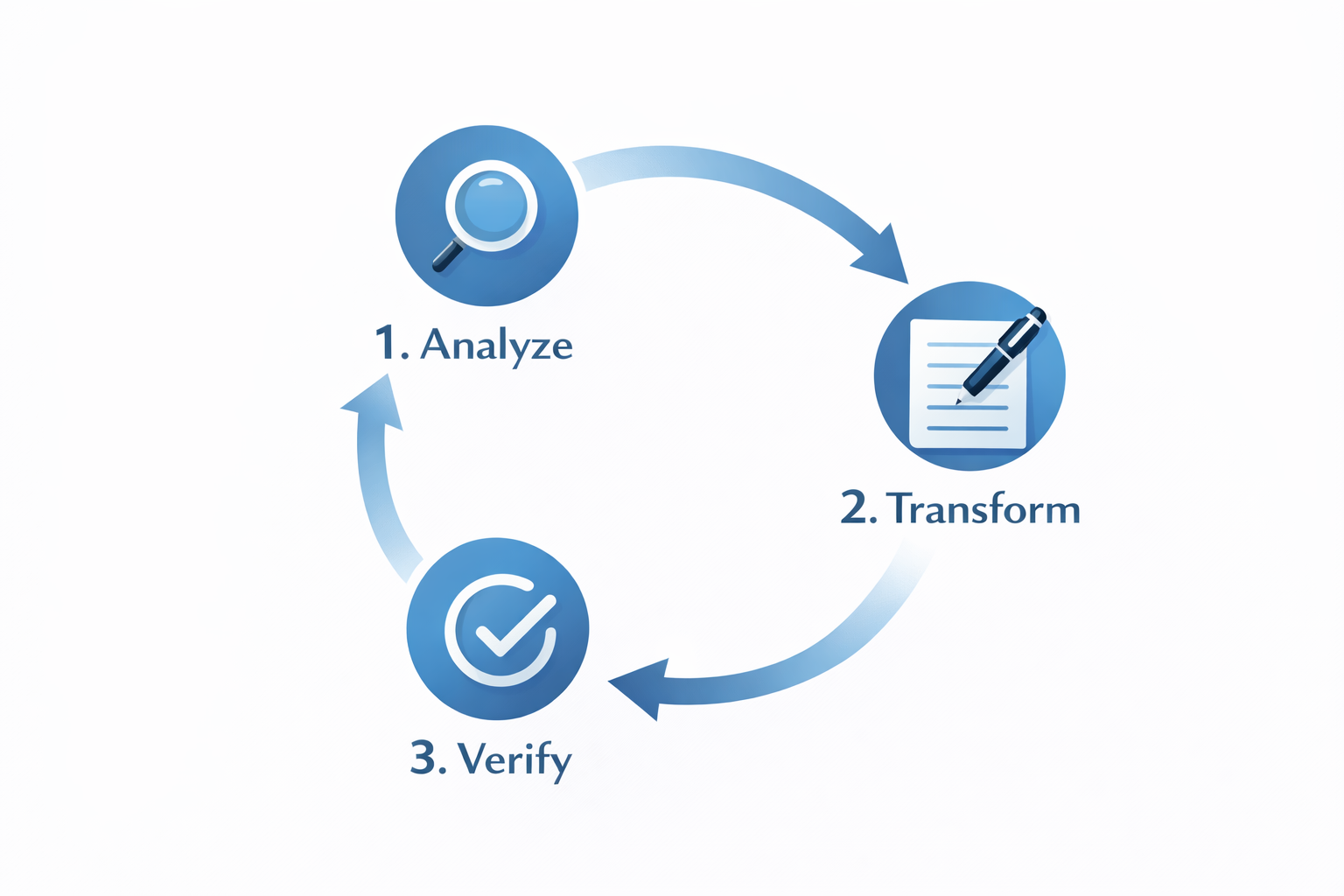
Image 2: The Systematic Rewriting Workflow. Professional content transformation follows a structured analyze-transform-verify cycle for optimal results.
Phase 1: Analysis & Deconstruction
Before rewriting a single word, understand what works and what doesn't. This analytical phase involves:
- Identify the Core Message: What's the article's primary thesis? What value does it provide?
- Define Target Audience: Who should read this? What's their knowledge level and intent?
- Assess Performance Metrics: Review traffic, engagement, rankings, and conversion data
- Pinpoint Improvement Areas: Identify structural issues, outdated content, missing information, and SEO gaps
Use tools like Google Analytics, Search Console, and readability analyzers to gather objective data. This evidence-based approach demonstrates Expertise and ensures strategic rewriting decisions.
Phase 2: Structural & Stylistic Overhaul
This transformation phase goes far deeper than word-swapping. Professional article rewriting means:
- Restructure for Flow: Reorganize sections for logical progression, add compelling headers, improve paragraph transitions
- Improve Readability: Break up dense paragraphs, use bullet points, add visual hierarchy, optimize sentence length
- Inject Fresh Voice: Replace passive constructions with active voice, eliminate jargon, add conversational elements
- Integrate New Information: Add updated statistics, recent case studies, current best practices, expert quotes
- Optimize Keywords: Naturally incorporate target keywords and semantic variations without stuffing
The goal is content that reads naturally while serving strategic objectives. Tools like Rephrazo can accelerate this transformation while maintaining your authentic voice. Explore AI rewriter tools for efficiency.
Phase 3: Refinement & Verification
The final phase ensures polished, accurate, and ethically sound content:
- Check for Consistency: Verify terminology, tone, formatting, and style alignment throughout
- Proofread Meticulously: Eliminate grammar errors, typos, and awkward phrasing
- Run Plagiarism Checks: Ensure originality and avoid unintentional duplication
- Verify Facts: Double-check statistics, quotes, and citations for accuracy
- Test Readability: Confirm appropriate reading level for target audience
- Optimize Technical SEO: Check meta tags, alt text, internal links, and schema markup
This verification step reinforces Trustworthiness and demonstrates commitment to quality. Learn about paraphrasing without plagiarizing for ethical content creation.
Rewriting vs. Paraphrasing: Understanding the Difference
While often used interchangeably, "rewriting" and "paraphrasing" serve different purposes:
- Paraphrasing restates a specific passage in your own words, maintaining the same length and detail level. It's ideal for incorporating source material while avoiding plagiarism.
- Rewriting is a comprehensive overhaul of an entire article involving restructuring, expanding, condensing, updating, and optimizing. It transforms content at a macro level.
Think of paraphrasing as sentence-level refinement and rewriting as document-level transformation. Both skills are essential for content professionals. Explore the best paraphrasing tools for your workflow.
Enhancing Productivity with Rephrazo
Professional article rewriting can be time-intensive, but modern tools dramatically improve efficiency without compromising quality. Rephrazo stands out as an invaluable asset for efficient and ethical article rewriting, upholding E-E-A-T principles throughout your workflow.
Inline Mastery: Instant, Contextual Rewrites
Rephrazo's inline hotkey workflow revolutionizes the rewriting process. Instead of copy-pasting between applications, you can:
- Select text directly in your writing environment (Word, Google Docs, email, etc.)
- Press a hotkey to trigger instant AI-powered suggestions
- Review and accept changes without breaking your creative flow
- Maintain focus and productivity throughout extended rewriting sessions
This eliminates the disruptive "copy-paste loop" that fragments attention and slows progress. Writers report 40-60% faster rewriting speeds with inline tools compared to traditional methods.
Contextual Intelligence: Maintaining Meaning and Tone
Built with contextual intelligence, Rephrazo analyzes surrounding content to ensure suggestions match your intended meaning, tone, and style. This preserves the Authoritativeness of your content by:
- Maintaining technical accuracy in specialized content
- Preserving your unique voice and writing style
- Adapting suggestions based on document context
- Offering multiple alternatives for different tones (professional, casual, academic)
Unlike generic paraphrasing tools that produce robotic output, contextual intelligence ensures rewritten content sounds authentically human.
Privacy First: Secure Local Processing
Rephrazo's commitment to local desktop processing means your drafts never leave your device. This provides:
- Complete confidentiality for sensitive business content
- Protection of intellectual property and trade secrets
- Compliance with data privacy regulations
- Peace of mind when working with client materials
This privacy-first approach reinforces Trustworthiness and makes Rephrazo suitable for professional, academic, and enterprise environments where confidentiality is paramount.
FAQ: Common Questions on Article Rewriting
Can I rewrite an article to improve its SEO ranking?
Yes, absolutely. Rewriting articles for SEO improvement is a proven strategy. When you update outdated information, incorporate current keywords, improve readability, and enhance overall quality, you signal to search engines that your content is fresh and relevant. Strategic rewrites can recover lost rankings and capture new search traffic. Focus on updating statistics, improving structure, adding internal links, and optimizing for current search intent. Articles refreshed with SEO in mind typically see ranking improvements of 15-30% within 2-3 months.
How much of the original content should I change when rewriting?
For a comprehensive article rewrite, aim for substantial transformation—typically 50-70% of the content should be modified or enhanced. This doesn't mean changing words arbitrarily; focus on structural improvements, rephrasing for clarity, adding new insights, and updating outdated information. The goal is creating a new expression of the ideas while maintaining core value. Minor edits (under 30% change) won't deliver meaningful SEO or quality improvements. Complete rewrites (90%+ change) may lose the original's strengths. Strike a balance that transforms while preserving what works.
Is it ethical to rewrite content from another source?
Ethical article rewriting depends on context and execution. It's ethical when you: use sources as references while creating substantially original content, add unique insights and analysis, properly attribute ideas and direct quotes, and transform rather than merely word-swap. It's unethical when you: simply paraphrase without adding value, fail to credit original sources, create derivative works without permission for commercial purposes, or engage in content spinning to deceive. Always ask: "Am I adding genuine value and expertise?" If yes, and you're citing sources properly, your rewriting is ethical. For academic contexts, consult your institution's guidelines. Learn about avoiding plagiarism in your work.
What's the difference between rewriting and plagiarism?
The key difference lies in transformation and attribution. Rewriting involves substantially transforming content—restructuring arguments, adding new perspectives, updating information, and expressing ideas in your unique voice. Plagiarism is presenting someone else's work as your own without proper attribution, even if you've changed some words. Ethical rewriting adds value through your expertise and experience. Use plagiarism checkers to verify originality, always cite sources for specific facts and ideas, and ensure your rewrite offers unique value beyond the source material. If your "rewrite" could be matched back to the original through a plagiarism checker, you haven't transformed enough.
How long does it take to rewrite an article professionally?
Professional article rewriting time varies based on article length, complexity, and rewriting depth. For a standard 1500-2000 word blog post: basic refresh (30-40% changes) takes 1-2 hours; comprehensive rewrite (50-70% changes) takes 2-4 hours; complete overhaul (70%+ changes) takes 4-6 hours. Technical or research-heavy content requires more time for fact-checking and verification. Using AI-assisted tools like Rephrazo can reduce these times by 40-60% while maintaining quality. The key is not rushing—thorough analysis and verification ensure your rewritten article delivers real value.
Conclusion: Master Article Rewriting for Content Success
Learning how to rewrite an article effectively is a game-changing skill for content creators, marketers, and business owners. Strategic rewriting breathes new life into existing content, improves search rankings, and maximizes your content ROI—all while requiring less effort than creating from scratch.
Remember the key principles: analyze before rewriting, transform structurally (not just superficially), maintain ethical standards and originality, optimize for both humans and search engines, and verify quality and accuracy thoroughly. Whether you're refreshing outdated content, adapting for new audiences, or optimizing for SEO, systematic rewriting delivers measurable results.
Modern tools like Rephrazo make professional-quality rewriting accessible and efficient. With inline functionality, contextual intelligence, and privacy-first architecture, you can transform content while maintaining your authentic voice and expertise.
Ready to elevate your content strategy? Download Rephrazo free and experience the power of intelligent article rewriting. Explore more resources on essay rewriting, different writing approaches, and writing more concisely.